
The Complete Guide to Planning a School Field Trip in New Jersey
From permission slips to chaperone ratios to choosing the right size bus, this is the practical, start-to-finish playbook New Jersey teachers and PTA volunteers actually need before booking their next field trip.

Why field trip planning in New Jersey deserves its own playbook
If you teach in New Jersey, you already know that planning a field trip here is different than almost anywhere else in the country. We have one of the densest school populations in the U.S., and we share a major metro region with two of the largest cities in America.
Our traffic patterns around the Lincoln Tunnel, Holland Tunnel, George Washington Bridge, and Walt Whitman Bridge can turn a 45-minute trip into a two-hour ordeal if you leave at the wrong time.
On top of that, every district has its own approval process. Every museum has its own group booking rules. Every bus operator has a slightly different way of quoting.
The teachers who plan smooth field trips year after year aren't smarter than the rest of us. They've just made all the mistakes already and built a personal checklist.
This guide is that checklist, written down, so you don't have to make those mistakes the hard way.
Start with the educational goal, not the destination
The most common mistake in field trip planning is picking a destination first and reverse-engineering the lesson plan. It works better the other way around.
Decide what you want students to walk away with, then find the place that delivers it.
A third-grade unit on colonial America points you toward Historic Cold Spring Village or the Old Barracks Museum in Trenton. A high school environmental science class lines up with the Meadowlands Environment Center or Cape May Point State Park. A middle school civics unit pairs naturally with the New Jersey State House.
Once the learning outcome is locked, the destination shortlist gets short fast.
And critically, you can defend the trip to your principal, your curriculum coordinator, and the parents who will ask why the school is funding a day out.
Field trips that get cut from budgets are almost always the ones without a tight educational rationale. Field trips that survive year after year are the ones every stakeholder can describe in one sentence: this is what students will learn, and this is where they need to be to learn it.
Build your timeline backward from the trip date
Most NJ schools require field trip approval six to eight weeks out. Charter buses for May and June book up by February in a normal year, and even faster around graduation season.
A realistic backward timeline looks like this.
Ten to twelve weeks out, lock the destination and submit your administrative request. Eight weeks out, send permission slips home. Six weeks out, book transportation.
Four weeks out, confirm chaperones and finalize the headcount. Two weeks out, send the final headcount to the bus company and to the destination so they can adjust staffing.
The week of, do a weather check and confirm pickup and drop-off logistics with the bus dispatcher. Day of, head out with a printed manifest in hand and a charged phone.
The teachers who plan trips with this kind of timeline almost never have last-minute crises. The teachers who try to compress the timeline into three weeks almost always do.
Get the headcount right before you ever call a bus company
This is where trips go sideways financially. Bus quotes are based on passenger count, and the per-student cost drops dramatically when you fill the bus.
A standard 56-passenger school bus costs roughly the same whether you put 30 students on it or 54.
If you have 38 fourth graders and only book one bus, you save real money. If you have 62 fourth graders, you need two buses, and your per-student cost effectively doubles.
Before you call for a quote, count students, count required chaperones, count classroom teachers, and add a buffer of two to three seats for the school nurse, paraprofessionals, one-on-one aides, or any administrators who may attend.
Most NJ districts require a 1:10 ratio for elementary and 1:15 for middle and high school, though your district may set tighter requirements.
Then add the names of any students with IEPs or 504 plans that require specific seating, accessibility accommodations, or proximity to a particular adult.
Get this right once, and the rest of the trip planning falls into place. Get it wrong, and you'll either be paying for empty seats or scrambling to add a second bus at peak-season prices three weeks before the trip.
Understand the difference between a school bus and a charter coach
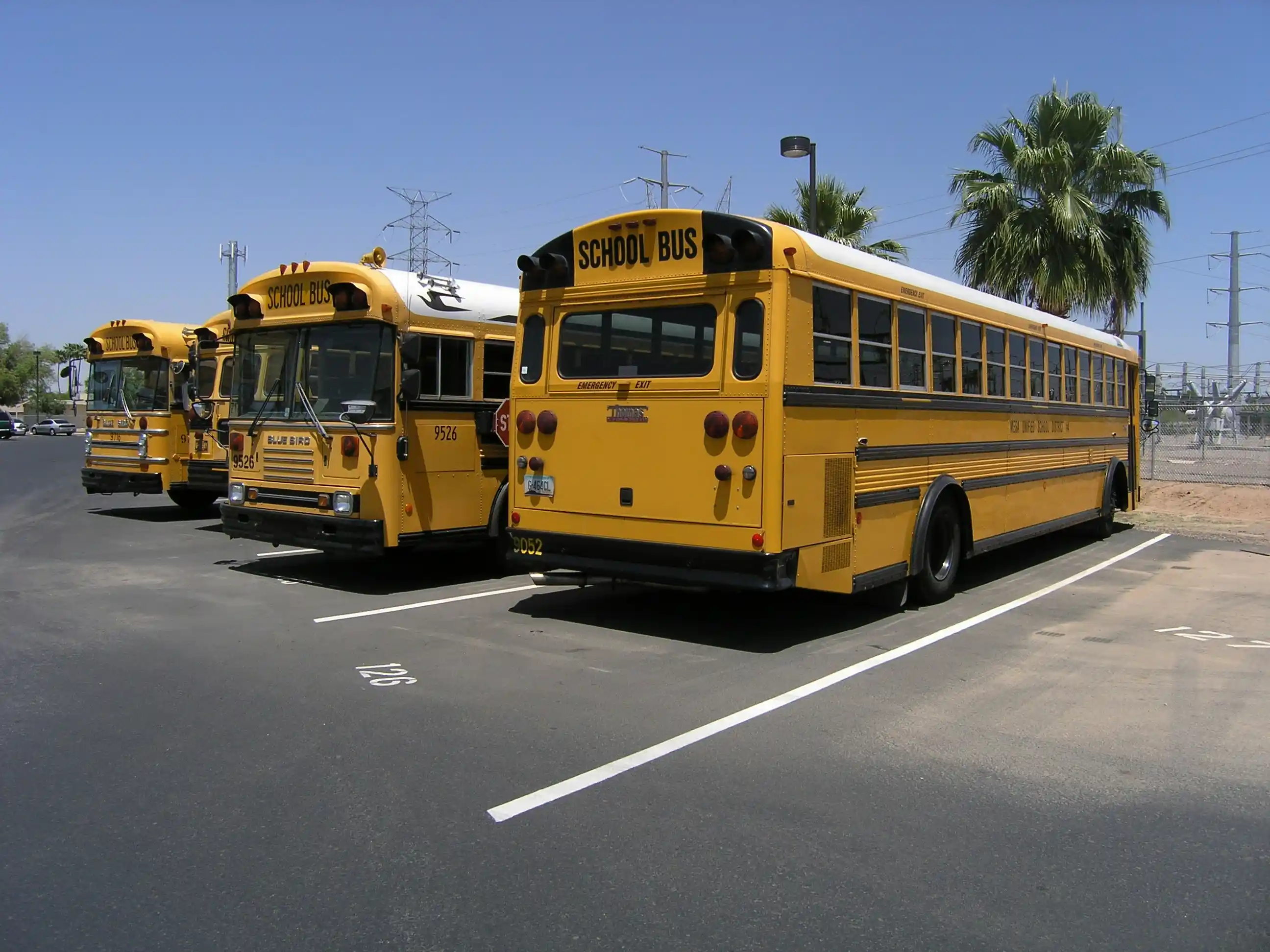
For most NJ field trips under two hours each way, a yellow school bus is the right call. It's cheaper, the driver is trained for student transport, and the bus is designed for the kind of in-and-out chaos that elementary trips create.
For longer trips, or when you want luggage space, restrooms, and reclining seats, a charter coach makes more sense.
The rule of thumb is straightforward. Under two hours each way and you don't need a bathroom on board, book a school bus. Over two hours each way, or any overnight trip, book a charter coach.
The few hundred dollars of difference on a longer trip pays for itself in driver attention, student comfort, and one extremely important amenity — an onboard restroom that prevents the need for highway rest stops with fifty middle schoolers.
For high school athletic teams, performance groups, and any trip where students need to arrive ready to perform, the coach is part of the performance, not a perk.
Permission slips and parent communication
NJ districts each have their own permission slip templates, but they all need the same core information.
That means trip date, destination, departure and return times, name of the transportation provider, chaperone list, total cost, and an emergency contact protocol that includes both school administration and the bus dispatcher.
Send the slip home with at least a three-week return window. Follow up with a reminder email at the two-week mark, then another at one week.
Build a tracking spreadsheet of who has returned slips and who has paid. Color-code it.
The single most stressful thing about the morning of a field trip is realizing two students never turned in slips and you have to call parents at 7 a.m. while simultaneously trying to load buses.
Build the system so that doesn't happen.
The teachers who use a shared Google Sheet visible to the front office have an easier time than the teachers who keep paper folders in their desk drawer. The office can answer parent calls without finding you in the middle of math.
Money: how to keep the trip affordable
Per-student costs add up faster than most teachers expect. Between the bus, admission fees, and lunch arrangements, a typical NJ field trip lands somewhere between $25 and $60 per student.
For families with two or three students attending similar trips in the same school year, this becomes a real budget item. Equity matters.
To bring the cost down, look at four levers.
First, fill the bus. Every empty seat is wasted money. Asking the office to coordinate with other classes going to similar destinations on similar dates can sometimes let you combine grade levels onto one bus.
Second, ask the destination about group rates and free chaperone admission. Most museums offer one free adult per ten students, and some offer fully sponsored Title I rates if your school qualifies.
Third, schedule on a Tuesday, Wednesday, or Thursday in shoulder seasons like March, early April, or late September. Bus rates run lower than peak Friday spring dates.
Fourth, pack lunches instead of buying on site. Bagged lunches can save $8 to $12 per student over museum cafes or food court stops, and the cafeteria can usually prep them if you give a week's notice.
For students whose families can't cover the trip cost, every NJ district has a mechanism — PTO funds, principal discretionary funds, Title I supplementation — and the front office knows how it works.
Use it. No student should miss a field trip because of money, and no teacher should pay out of pocket to cover gaps.
Chaperone logistics
Recruiting chaperones is half the job. Start with a sign-up email two months out, and be specific about what you need.
Meet at school by 7:30 a.m. Ride the bus. Supervise a group of five students. Return by 3:00 p.m. No younger siblings allowed, no exceptions.
Many parents want to chaperone but don't know what they're signing up for. Make it concrete.
On the trip itself, assign each chaperone a numbered group with a printed roster and photos if you can manage it. Exchange cell numbers in a group text the day before.
The group text is non-negotiable. It's how you find a missing child in three minutes instead of thirty.
Brief chaperones for ten minutes before students load the bus. Cover where you're going, what the schedule is, where you'll meet if anyone gets separated, which adult is the designated point person for medical issues, and what the dress code is at the destination.
A well-briefed chaperone is an asset. An unbriefed chaperone is a liability. The ten minutes is worth it.
Day-of logistics that actually matter
Print three copies of your manifest. One for you, one for the bus driver, one to leave with the front office.
The office copy matters in a worst-case scenario. If anything goes wrong, your principal needs to know exactly who is on which bus without having to call you.
Bring a first aid kit. Bring the medication binder from the school nurse for any students who need scheduled doses. Bring extra blank permission slip copies in case of paperwork issues. Bring a roll of contractor-grade trash bags for the bus on the way home — every elementary teacher learns this lesson exactly once.
Bring a phone charger and a printed itinerary with destination phone numbers.
Do a headcount at every transition. Getting on the bus, getting off at the destination, after restroom breaks, after lunch, before leaving the destination, and before pulling out of the parking lot.
Five to seven counts, every time, no exceptions. Announce the number so chaperones know what to verify.
The teachers who lose track of students are not bad teachers. They're teachers who skipped a count.
What to do when something goes wrong
Buses break down. Kids get sick. Destinations close exhibits without warning.
The trip you've planned for three months will throw you a curveball, and how you handle it matters more than whether it happens.
Have the bus company's dispatch number saved in your phone, not just buried in an email thread. Have the school nurse's cell number. Have your principal's cell number. Have your assistant principal's cell number as a backup.
Know which hospital is closest to your destination, and program its general number into your phone before you leave.
For NYC trips, NewYork-Presbyterian and Mount Sinai both have urgent care locations near common school group destinations. For Philadelphia trips, CHOP is the children's hospital and has urgent care affiliates. For shore trips, Jersey Shore University Medical Center in Neptune is your reference point for central NJ coast destinations.
None of these phone calls are likely. But the one time you need them, you'll be grateful you didn't have to dig through a folder while a sick kid waits.
The post-trip work nobody talks about
After the trip, send a thank-you email to chaperones within 48 hours. They gave up a workday, and a quick personal note keeps them volunteering next time — and you will need them again.
Have students write reflections, even a single paragraph, so you have qualitative evidence for next year's administrative approval.
Some teachers have students write postcards to the destination thanking specific staff members. This builds future goodwill for return trips and sometimes results in surprise perks the next year.
Block twenty minutes for yourself to debrief. What worked, what didn't, what you'd do differently.
Write it in a Google Doc you keep year over year, titled something like "Field Trip Lessons" or "What I Wish I Knew Before [Destination Name]."
Field trip planning gets dramatically easier the second time, and exponentially easier the third. Most of the friction is in the things you don't know to anticipate.
Capture them while they're fresh. Within six months you'll have forgotten the small things — which exit to use at the rest stop, which gift shop the bus driver prefers parking near, which restroom location works best for a class of fifty — and those small things are exactly what makes year-two planning fast.
A note on transportation partners
The single biggest variable on the day of the trip is the bus operator. A great driver makes a chaotic trip feel calm. A great dispatcher makes a 6 a.m. weather emergency feel like a non-event.
When you're evaluating bus companies, ask three questions. How old is your average vehicle? What's your on-time arrival rate for school trips? Who is the human I will call if something goes wrong on the day of the trip?
Anyone who can answer those three questions specifically is a serious operator. Anyone who deflects is not.
At Maytav Bus, those are conversations we have with planners every week, and we'd rather give you a clear answer than win on price alone.
When you're ready to talk through a specific trip, we're happy to walk through pricing, vehicle options, and logistics with you — no obligation, no pressure.
Either way, the most important thing is that your students get there safely and have the day you planned for them.