
School Bus vs. Charter Bus: Which Should You Book for a Field Trip?
Yellow school bus or charter coach? The choice comes down to three honest questions about trip length, on-board restrooms, and luggage. Here's how to pick the right vehicle for your next field trip.

The school bus versus charter bus decision is simpler than it looks
Most field trip planners spend more time agonizing over this choice than they need to.
The decision actually comes down to three questions. How long is the trip. Do you need a bathroom on board. Is luggage involved.
Answer those three honestly and the right bus picks itself.
This post is here to make that obvious, walk through the real differences between vehicle types, and explain when each one is the right tool for the job.
What a school bus actually is
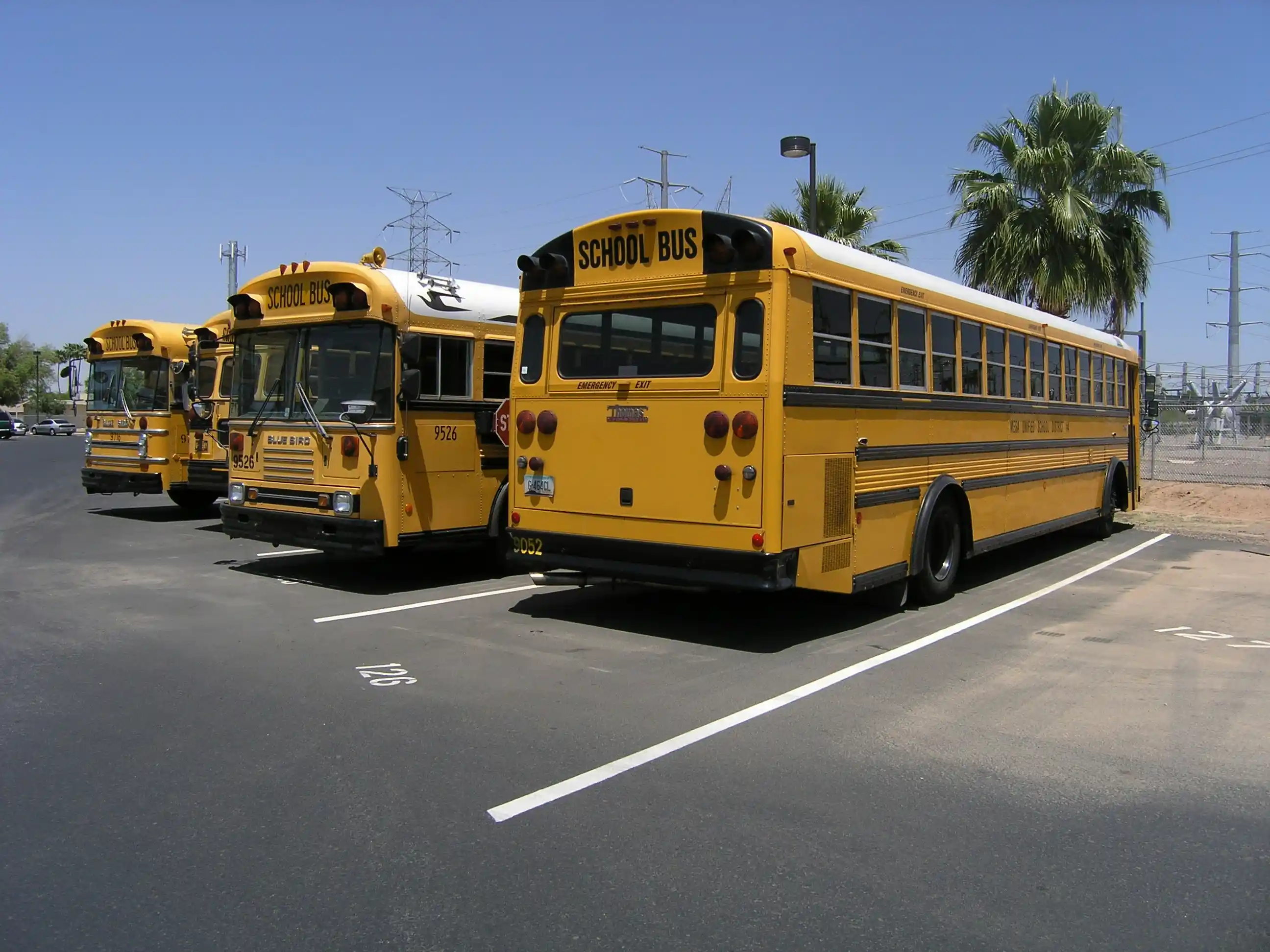
The yellow school bus you've ridden a thousand times is officially called a Type C or Type D school bus.
It seats 47 to 72 passengers depending on the configuration.
It has bench seats with vinyl covers, no restroom, no luggage compartment, and — critically — is built to a specific federal safety standard (FMVSS) that's stricter than passenger vehicle standards.
The yellow color, the high seat backs, the flashing reds and ambers, the stop arm: all of that is regulated.
School buses are the safest passenger vehicles on American roads by a wide margin, statistically.
They're built for one job: moving children safely on routes of moderate length.
What a charter bus actually is
A charter bus — also called a motor coach — is the big highway-style bus you see on tour groups and corporate shuttles.
Standard configuration is 47 to 56 reclining seats.
It includes an onboard restroom, overhead bins, luggage bays underneath, climate control rated for highway speeds, often Wi-Fi, USB outlets, and sometimes seatbelts on newer models.
It's built for distance and comfort, not for school-bus-style multi-stop pickup routes.
If you've ever taken a Greyhound or seen a sports team roll up to a stadium in a black-and-silver bus, you've seen a charter coach.
The three questions that decide everything
Question one: how long is the one-way trip?
Under two hours one-way and under five hours total, a school bus is almost always the right choice.
Two to three hours one-way is the gray zone where either can work.
Over three hours one-way, the charter coach becomes the clear winner.
Question two: do you need a bathroom on board?
If your trip will exceed two and a half hours without a planned rest stop, you want a charter coach.
School buses don't have restrooms, and stopping a school bus at a rest area with 50 kids is a logistical event of its own.
Question three: is there luggage?
Overnight trips, performance trips with instruments or uniforms, multi-day sports tournaments — all of these require under-bus luggage storage.
School buses don't have luggage bays. The aisle and the seats are your only storage.
If you can answer these three questions, the bus type is decided. The rest is just confirming details.
Cost comparison
For the same trip, a charter coach typically runs 40 to 70 percent more than a yellow school bus.
A four-hour local trip might be $900 on a school bus and $1,400 on a coach.
A full-day Philadelphia trip might be $1,500 on a school bus and $2,400 on a coach.
The cost difference is real. But the value question is different at different trip lengths.
On a one-hour zoo trip, the coach is overpaying for amenities you don't need.
On a five-hour trip to Hershey Park, the coach pays for itself in driver attention (less student fatigue), bathroom access (no rest stops), and student behavior (kids are calmer in reclined seats than on vinyl benches).
Comfort isn't a luxury for older students
Here's the part people underestimate.
By eighth grade, students don't fit comfortably in school bus seats designed for elementary-aged bodies.
By high school, they're cramped.
For a middle school or high school trip over two hours, the coach isn't an upgrade — it's appropriate.
Football team trips to South Jersey from North Jersey on a yellow school bus produce sore, irritable players.
The same trip on a charter coach produces players who can warm up and compete.
If you're transporting athletes or performers who need to perform when they arrive, the coach is part of the performance, not a perk.
Safety: both are extremely safe, in different ways
School buses are safer per mile for in-town and suburban transport.
They're built to absorb low-speed impacts, they're highly visible, and they stop traffic with their lights.
Charter coaches are safer per mile for highway transport.
They have higher seat backs relative to passenger height, three-point belts on many newer coaches, and crash structures designed for highway speeds.
Both vehicle types in NJ require commercial-licensed drivers with current medical certifications.
The question isn't which is safer in absolute terms — they're both very safe — but which is built for your trip profile.
Sight lines and chaperone control
School buses have a unique advantage for elementary trips. The driver and chaperones can see the entire passenger compartment from any seat.
High-back coach seats block sight lines, which is why coaches feel "adult" — they were designed for adults who don't need supervision.
For first through fifth graders, the visibility of a school bus is a feature, not a bug.
For eighth graders and above, the privacy of a coach is fine.
For middle school, it depends on the group. If your sixth graders behave like fourth graders, school bus. If they behave like ninth graders, coach.
The mixed-fleet option
For schools running multiple buses on the same trip, you don't have to pick one type.
We've seen setups where chaperones and high schoolers ride one charter coach, and younger students ride two school buses, all to the same destination.
It's not common, but it's available, and for trips with mixed age groups it can solve problems neither vehicle type solves alone.
If you have a multi-grade trip with very different needs across the grades, ask your operator whether a mixed fleet is possible.
What about ADA accessibility?
This matters and deserves its own paragraph.
Both yellow school buses and charter coaches can be ordered with wheelchair lifts. ADA-equipped vehicles are not standard inventory.
They have to be requested at booking, and inventory is limited statewide.
If any student on your trip uses a wheelchair, mention it the first time you call for a quote, not on the day of the trip.
The operator needs lead time to confirm an accessible vehicle and route, and to brief the driver on tie-down protocols.
The two questions to ask the operator before you book either type
One: "What's the age of the vehicle you'll send for this trip, and what's the maintenance interval?"
Modern coaches and modern school buses are very different from 15-year-old equipment.
Two: "Will you provide a single driver for the round trip, or will a relief driver be needed?"
If a relief driver is needed, that affects price and the operator's logistics.
Asking forces a real answer instead of a vague reassurance.
The default answer for most NJ field trips
If you're a teacher planning a single-day trip to a destination within two hours of your school, with no luggage and a planned rest stop if needed, book a yellow school bus.
It's the right call 80 percent of the time.
The other 20 percent — longer trips, overnight, performance trips, sports tournaments — book a coach and don't second-guess it.
The few hundred dollars of difference is the cheapest insurance you'll buy that day.
At Maytav Bus we run both yellow school buses and charter coaches across New Jersey, and we're happy to talk through which one fits your specific trip before you commit. Either way, the rule of thumb to remember is this: short and local means school bus, long or overnight or luggage means coach. Everything else is detail.